

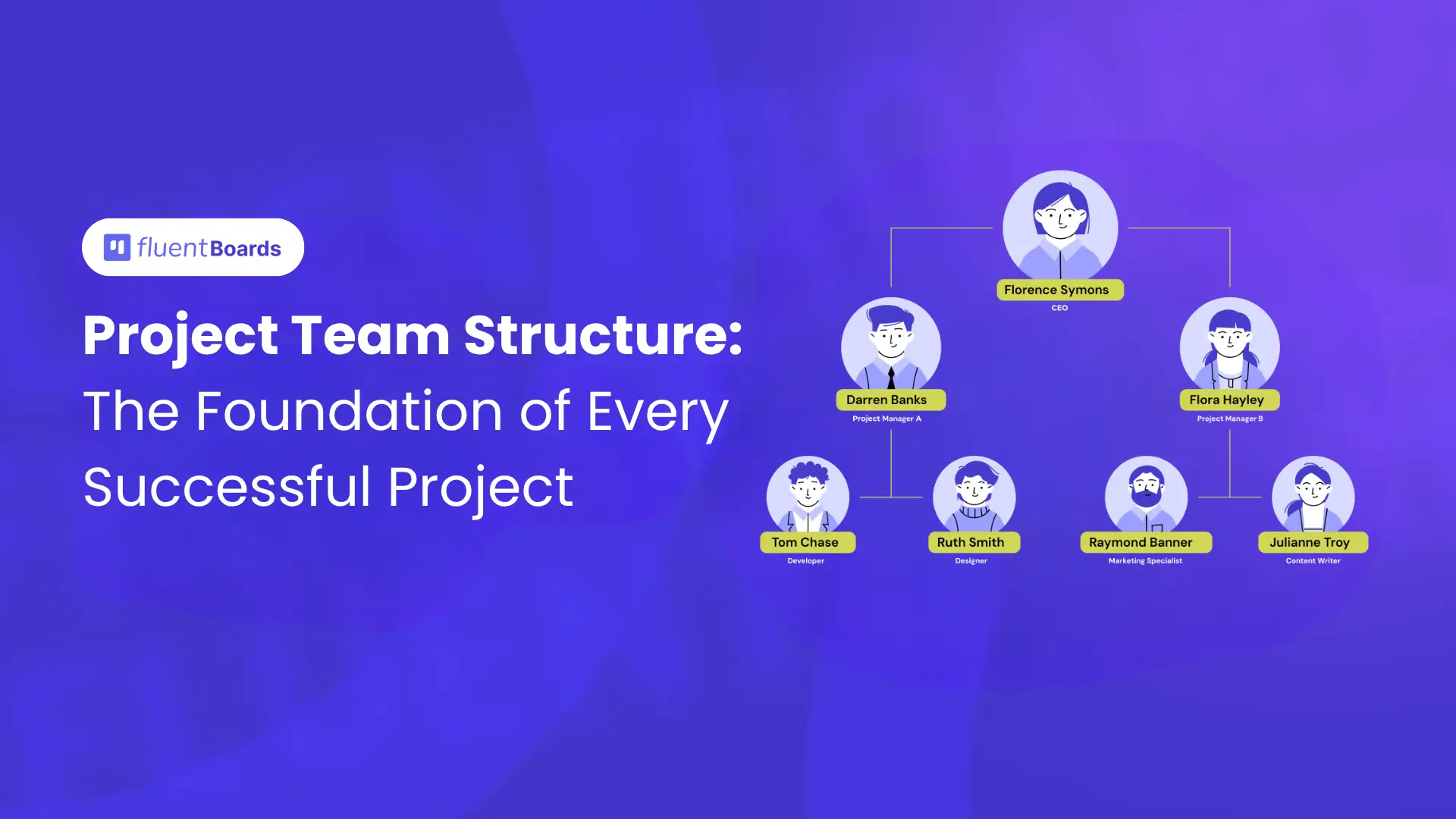
Project Team Structure 101: Everything You Need To Know About Project Management Organizational Structure


You’ve got an amazing project in hand and a list of skilled team members ready to dive in, and you’re all set to take off!
But wait! Have you missed a key step?
Without clarifying who is accountable for what and who will report to whom for updates and necessary changes, wouldn’t the project execution turn into a mess?
And, this is where the importance of having a solid project team structure comes into play. To increase your project’s chances of success, you must first organize your team before making the final moves.
Curious to learn more about project management organizational structures, their types, and how to choose the right one?
Buckle up then—it’s reading time!
What Is the Project Team Structure?
Project team structure refers to how roles, responsibilities, and relationships are organized within a project team. It defines how team members collaborate, who reports to whom, and how decisions are made.
In general, a project team consists of various members with different skill sets. To ensure the team is aligned and succeeds in its mission, it’s important to have a clear, strategic, and structured approach.
And, this is where the project team structure comes in. It aligns everyone and organizes team members by defining their roles, the responsibilities they are accountable for, and who will be the leader or “captain of the ship,” ensuring the team moves forward with purpose and coordination.
Additionally, the team structure impacts how communication flows within the group. Thus, in the long run, it brings transparency, accountability, and a more collaborative environment, where everyone works toward a common goal—not just as individuals, but as a team.
Level up your project management game inside WordPress – where limitless possibilities come at an unbeatable price!
5 Most Commonly Used Project Team Structures
There are various types of project team structures, each suited to specific needs. However, most organizations commonly use one of these five structures to organize their teams:
- Functional project team structure
- Project-based team structure
- Matrix-based team structure
- Process-based team structure
- Product-focused team structure
Let’s dive in and explore each type in detail!
Functional project team structure
The functional project team structure divides the company into departments based on their expertise. Each department is managed by a functional manager who is responsible for the team’s work in that area. These managers report to a top executive like the CEO.
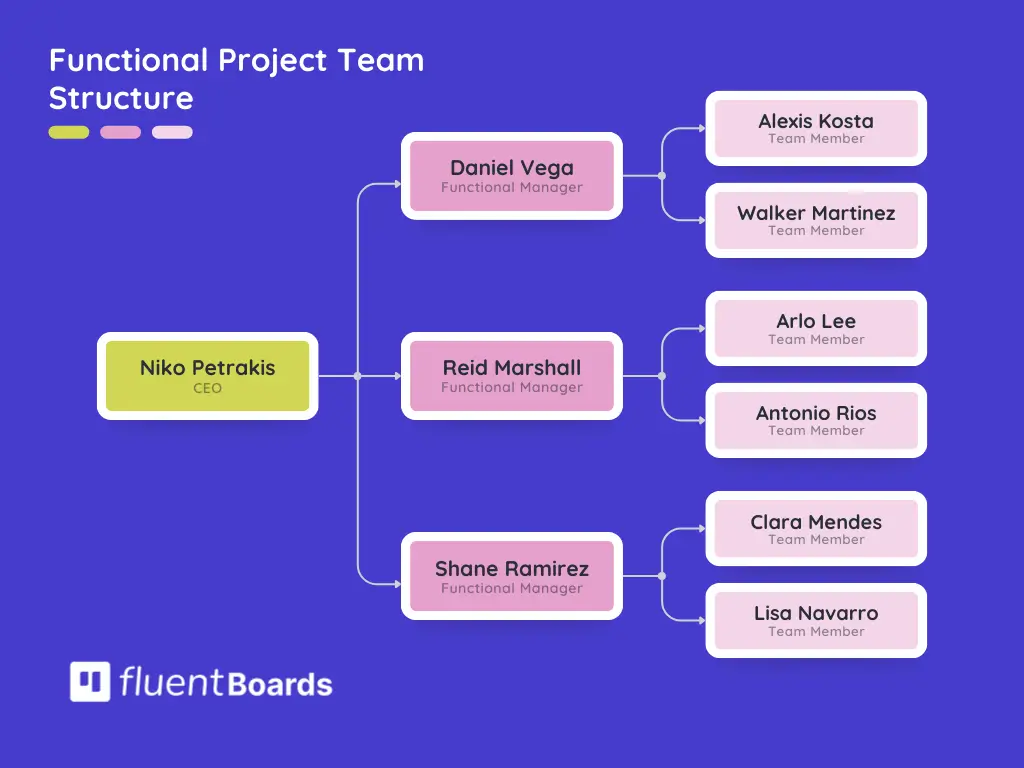
Functional managers provide oversight, manage resources, and ensure that work aligns with the organization’s strategic goals. When projects arise, team members temporarily join the project but continue to report to their functional managers.
This way, the project gets the right skills and knowledge, and the departments maintain a steady flow of work.
Best fit: This structure is ideal for large organizations focused on a limited range of products or services, as it improves consistency and resource efficiency within specialized departments.
Here’s where this structure pays off and where it pulls back:
Pros:
- Specialized expertise stays concentrated within each department
- Team members have a steady career path and a clear reporting line
- Workload and resource use are predictable
Cons:
- Project work can take a back seat to departmental priorities
- Cross-departmental communication often slows down
- Project managers have limited authority over team members
Project-based team structure
A project-based structure is a team organization model where employees are temporarily assigned to dedicated project teams to complete specific projects.
You’ll also see this structure called a dedicated project team structure or a projectized structure. They all describe the same setup, just with different names depending on the source.
These teams are formed by pulling individuals from various departments and are led by a project manager who reports directly to upper management or the CEO.
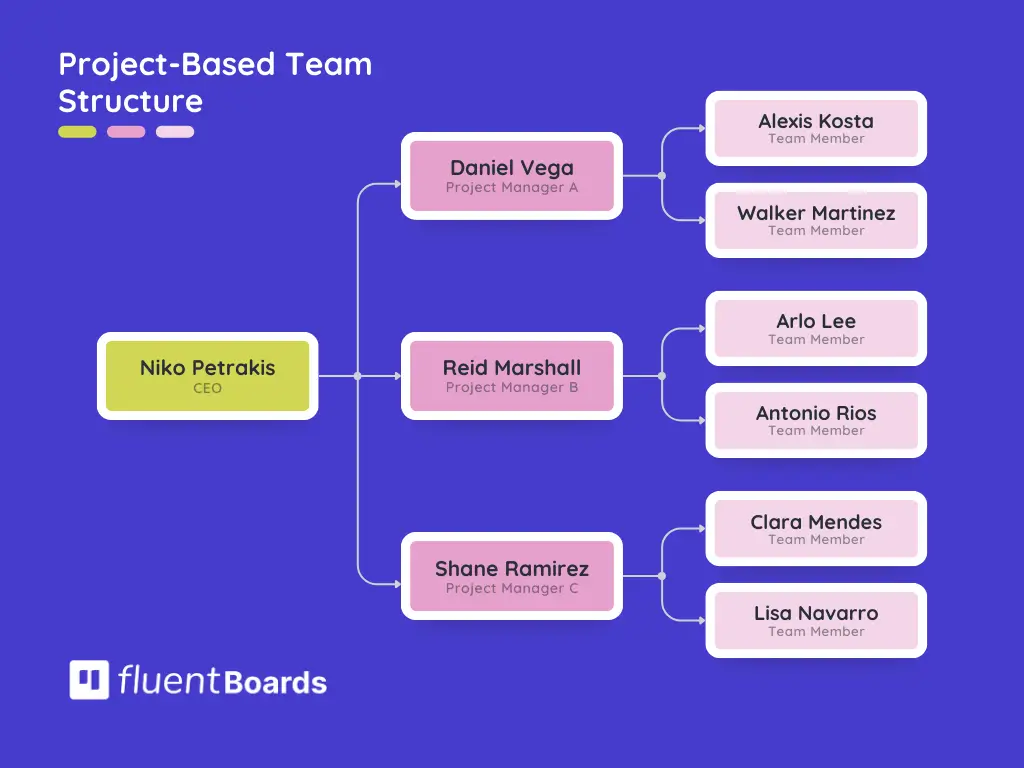
The project manager has full authority over the team’s activities, roles, and resource allocation to deliver the project on target.
And, once the project is completed, the team may disband, and members return to their original departments or take on new projects, making this structure effective for organizations that need a flexible, goal-oriented approach.
Best fit: This setup works well for small companies, startups, and organizations handling multiple projects simultaneously, where focused teams with clear project goals and authority are essential.
Here’s what this setup delivers and where it costs you:
Pros:
- The project manager has full authority, so decisions get made fast
- Team members focus on one project without competing priorities
- Goals stay clear because the whole team works toward the same outcome
Cons:
- Resources can sit idle between projects unless they get reassigned quickly
- Team members can feel disconnected from their home departments
- Knowledge gained on one project can get lost when the team disbands
Matrix-based project team structure
In a matrix organization, employees have two managers: one for their function and another for their project. This structure balances specialized expertise with project-specific focus.
Team members work under the shared guidance of both functional and project managers to complete project goals.
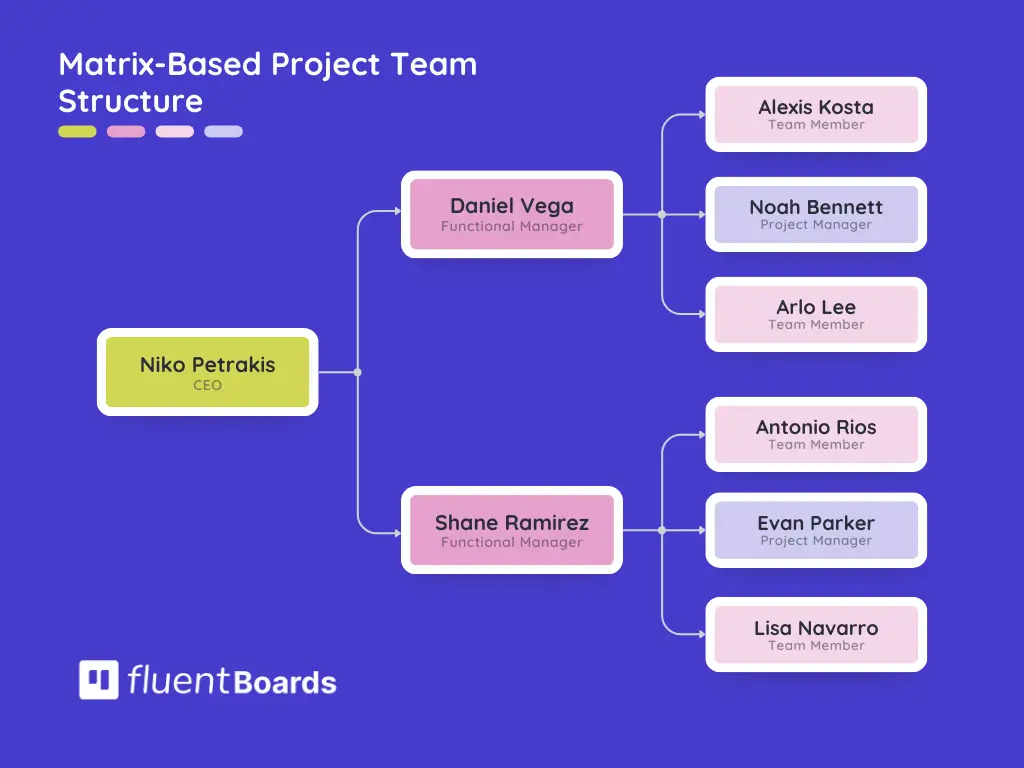
This setup encourages teamwork across different departments, allowing organizations to make the best use of their skills and knowledge on multiple projects.
This cross-functional collaboration enables organizations to share expertise across multiple projects. However, clear communication and cooperation between project and functional managers are required to prevent conflicts.
Matrix organizations work in different ways depending on how much power and responsibility each manager has.
Here’s a simple breakdown of the types of matrix organizations:
- Strong matrix: Project managers have more authority over resources and decision-making, while functional managers provide support in a limited role.
- Weak matrix: Functional managers hold more authority, with project managers acting as coordinators or advisors.
- Balanced matrix: Authority is shared between project and functional managers, with decision-making and responsibilities divided equally.
Best fit: This structure suits organizations that manage multiple projects and require team members to collaborate across departments, promoting skill development and flexibility.
Here’s the trade-off this structure asks you to accept:
Pros:
- Skills move across multiple projects without needing extra hires
- Team members keep their functional career path while contributing to projects
- Organizations get more value from specialists who are in short supply
Cons:
- Two managers means competing priorities and slower decisions
- Communication overhead is high
- Team members can feel pulled in two directions when deadlines clash
Process-based team structure
A process-based structure focuses on core workflows rather than traditional departments. Each major process (like production, sales, or support) operates as an independent unit managed by a process leader who reports to upper management, like the CEO or other executives.
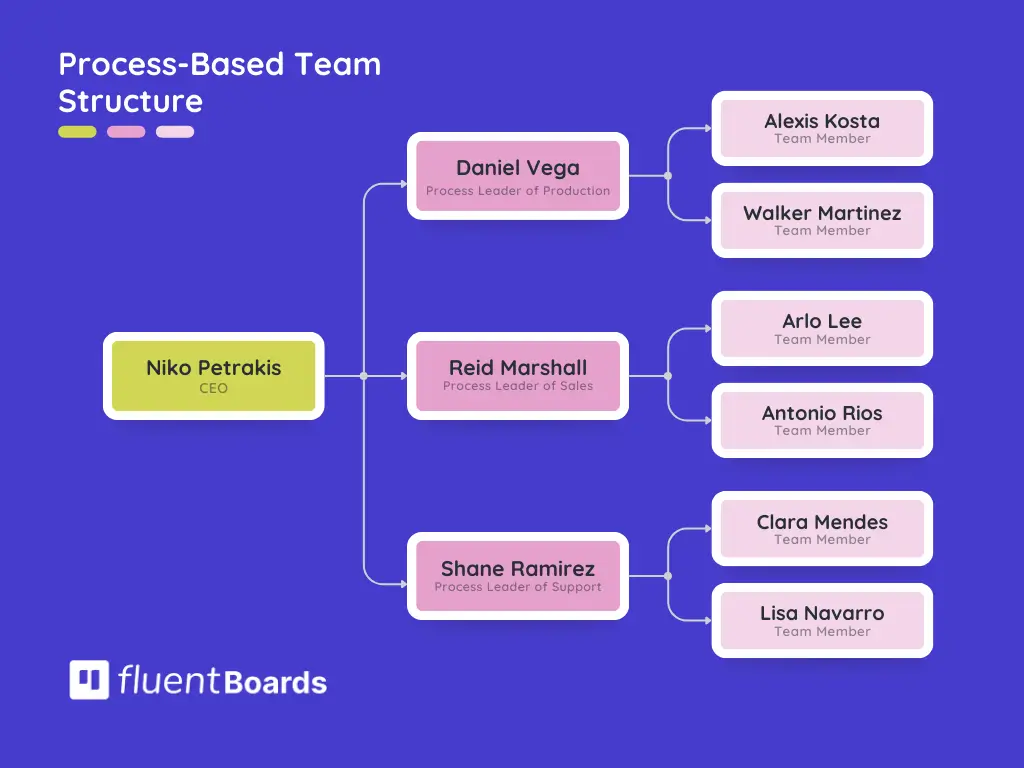
Process-based teams work to make core workflows better. They use individual skills and teamwork to simplify tasks and remove obstacles. This setup works well for industries that need productivity and well-coordinated processes.
Best fit: Process-based structures are highly effective in industries prioritizing efficiency and continuous improvement, as they make it easier to streamline operations and address process-related challenges.
Here’s what this structure does well and where it struggles:
Pros:
- Workflows get continuous attention and improvement
- Bottlenecks are easier to spot because each process has a clear owner
- Teams build deep expertise in the process they own
Cons:
- Cross-process projects need extra coordination effort
- New initiatives that don’t fit an existing process can stall
- Less flexible when the business changes direction quickly
Product-focused team structure
A product-focused structure is organized around different product lines or services, with each product team responsible for all aspects of its specific product.
Each product line has a dedicated team, including managers, designers, marketers, and support staff, who report to a product lead or product manager and, ultimately, to the executive team or CEO.
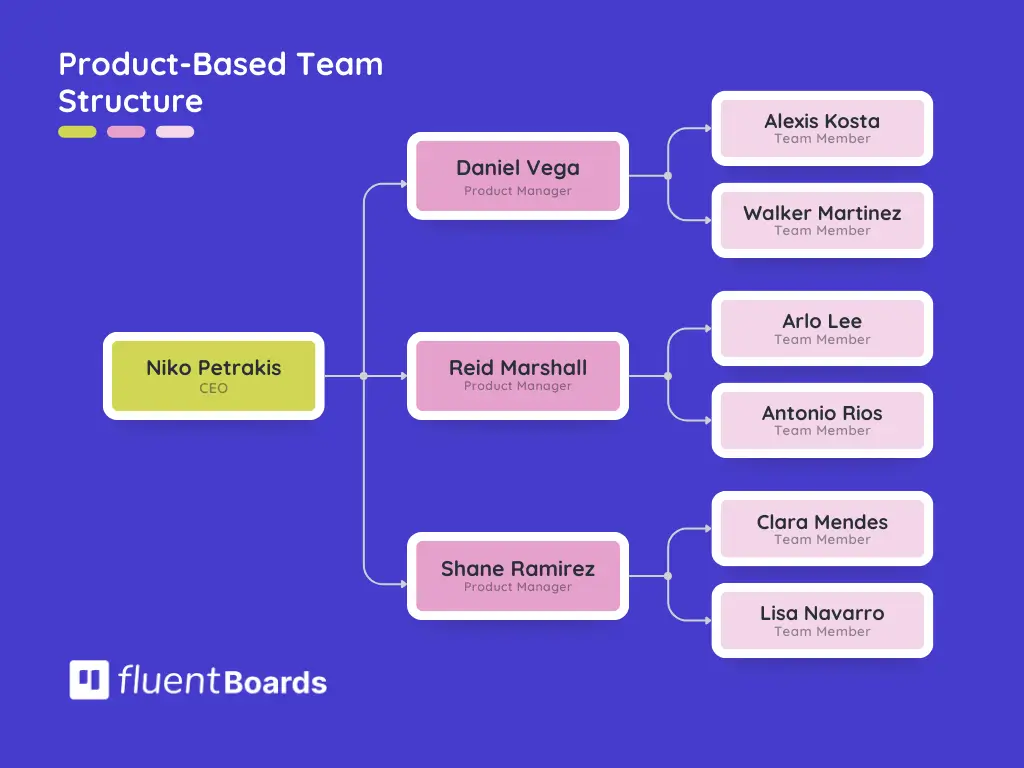
This setup allows teams to focus deeply on the needs, development, and success of each product, enabling quick responses to market demands and strategic adjustments specific to each product.
Best fit: This structure works well for companies with diverse product lines, as it allows each team to focus entirely on the success and market responsiveness of their specific product.
Here’s what you gain and what you give up:
Pros:
- Teams stay close to their product’s customers and market
- Decisions get made quickly because the team owns the full picture
- Product knowledge builds up over time within the same team
Cons:
- Skills can get duplicated across product teams
- Cross-product collaboration takes more effort to organize
- Smaller product teams may lack specialists who’d otherwise be shared
A Side-by-Side Comparison of the 5 Structures
The table below summarises the five structures across the four factors that usually drive the decision: how much authority the project manager has, the type of project the structure is best for, the reporting lines, and how flexible the structure is with resources.
| Structure | Project manager authority | Best for | Reporting lines | Resource flexibility |
|---|---|---|---|---|
| Functional | Low | Small, single-department | One manager (functional) | Low |
| Project-based | High | Medium to large, single focus | One manager (project) | Medium |
| Matrix-based | Shared with functional manager | Medium to large, multi-project | Two managers | High |
| Process-based | Limited within a process | Process-driven operations | Process leader | Low to medium |
| Product-focused | High within the product line | Multi-product organizations | Product lead | Medium |
How to Choose a Suitable Structure for Your Project Team
Deciding on a project management organizational structure and fully committing to it for success requires a clear understanding of all necessary factors and determining what best fits your needs.
That’s why we suggest –
1. Understand your project goals and define a clear workflow
Begin by clearly defining the objectives of your project. Ask yourself –
- Is it a one-time initiative or a long-term endeavor?
- Does it require specialized skills or cross-departmental collaboration?
- What project management workflow does your team prefer to follow?
Having clear answers to these questions will work like magic and guide you toward a structure that aligns with your project’s vision and complexity. Which can then be effectively communicated to stakeholders using a presentation maker to visualize team roles and workflows.
2. Consider your project timeline and budget
The project timeline and budget are vital factors in selecting the appropriate structure. If the project has a tight deadline or requires rapid decision-making, a projectized structure may be the best option.
However, if the project is long-term with a larger budget, a more collaborative structure (like a matrix) may provide the necessary flexibility while ensuring cost control.
3. Decide the roles and responsibilities
First, decide how many individuals you’ll need in your team to execute the project successfully. Also, determine what roles of the project team you want to assign to them.
Remember, this is the most important step to ensure a smooth workflow.
4. Evaluate your team’s skills and availability
Assess the expertise and availability of your human resources. A functional structure works well if your team members possess specialized skills and need to focus on specific tasks.
On the other hand, a matrix structure is better suited for projects requiring team members to juggle multiple responsibilities.
5. Consider the tools at your disposal
The availability and functionality of tools can play a key role in determining how well a structure performs. That’s why, take stock of the tools and technology available to you.
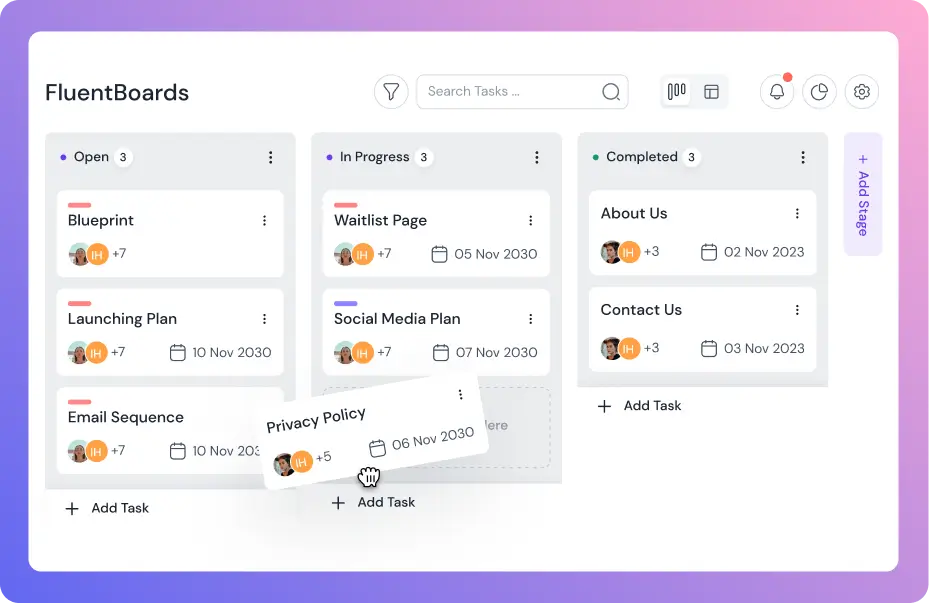
A handy project management collaboration tool like FluentBoards can streamline communication and task management, making even complex structures manageable.
Step into the Future of Project Management!
6. Account for risk factors
Evaluate the risks associated with your project and choose a structure that helps mitigate them.
For example, a projectized structure may be better for high-risk, high-priority projects because it provides more control and quicker decision-making, while a matrix structure can distribute the risks more evenly across different teams and functions.
7. Match the structure to your needs
Each structure has its strengths and its limits, and the right choice depends on what your project actually needs from it.
Look for one that gives your team enough flexibility to move quickly, while keeping roles, responsibilities, and reporting lines clear enough that no one is guessing.
8. Iterate and adapt
Remember, no structure is one-size-fits-all. Start with the one that seems most suitable and be open to adapting as the project evolves.
Regularly review the structure’s effectiveness and make adjustments to ensure it supports your project’s progress.
For more practical guidance as you go, see our project management tips
How These Team Structures Apply to Real Projects
The five structures we’ve covered can look very different depending on the type of project a team is running. Here’s how the most common project types map to these structures in practice.
Marketing teams and campaign projects
Marketing teams usually run on a matrix structure. Specialists like designers, writers, SEO leads, and ad managers each report to their function head, but they also work under a campaign manager for the duration of each launch. This lets the same specialist contribute to multiple campaigns without being locked into a single product line.
Smaller marketing teams often use a functional structure instead, where everyone reports to a single marketing manager and project work happens inside the department.
Software development teams and product projects
Development teams typically use a product-focused or project-based structure. The squad model is the modern version of product-focused. Each squad owns one product or feature area with developers, designers, QA, and a product manager dedicated to it.
For agencies or shops building software for clients, project-based is more common. A dedicated team forms around each client engagement, ships the project, and either disbands or moves to the next one.
Agency client projects
Agencies almost always work in a project-based structure. Each client engagement is essentially a project, with a project manager owning the timeline and a small dedicated team pulled together for the duration.
If you run a WordPress agency, our walkthrough of how FluentBoards helps agencies manage projects shows what this setup looks like in practice.
When an agency grows large enough to run many client projects in parallel, the structure often shifts toward matrix. Specialists get shared across multiple client teams, with both an account-level project manager and a function head.
Remote and distributed teams
Remote and hybrid teams use whichever structure their work demands. Being remote or distributed doesn’t change the structure itself, it changes how communication and coordination happen inside it.
A remote marketing team still tends toward matrix. A remote dev team still tends toward squads. The structure is the same, the tooling and communication patterns are what change.
Quick reference: team structures by project type
The table below summarizes which structures fit which project types and what a typical team composition looks like.
| Project type | Typical structure | Team composition | Why it fits |
|---|---|---|---|
| Marketing campaigns | Matrix | Marketing manager plus specialists in design, content, SEO, and ads, shared across campaigns | Specialists work on multiple campaigns at once; campaign manager coordinates |
| Software products | Product-focused (squad) | Product manager plus developer, designer, and QA dedicated to one product | Each squad owns one product end to end |
| Agency client work | Project-based | Project manager plus a dedicated team for each client engagement | Teams form, ship, then disband or move to the next client |
| Remote and distributed teams | Any of the above | Same composition as the structure type, distributed across locations | Distribution affects communication, not the structure itself |
Importance of Having a Good Project Team Structure
A clear team structure can make the difference between chaos and smooth progress. Here are the advantages that come with a well-structured project team:
- Clear communication keeps the team on the same page, aligns goals, and makes project team management much simpler
- Defined roles and responsibilities help teams focus on tasks, ensuring accountability as well as risk management
- With the help of a structured approach, you can take full advantage of team collaboration by welcoming new ideas, leading to better solutions
- Sharing duties within the team creates a supportive environment where all members feel responsible and deal with project management problems together
- Quick reviews provide feedback, helping team members identify strengths to improve
- An organized project team increases speed, effectiveness, and flexibility by assigning tasks based on skills and availability
- A solid project plan ensures tasks are organized, leading to on-time delivery and cost savings
Develop a Strong Project Team from the Root Level
Your project team structure is like the roots of a tree. When those roots are strong, the whole tree can stand tall, even when storms come out of nowhere.
The five structures we’ve covered each fit a different kind of work. Pick the one that matches how your team actually operates, commit to it long enough to see results, and adjust as your projects change.
Thanks for reading this far. Now, it’s time to develop and apply what you’ve learned!
Frequently Asked Questions
Have more questions about the project team structure? We’ve got you covered!
Let’s redefine project management with FluentBoards!

Follow:


Get Tips, Tricks, & Updates
We won’t send you spam.





Add your first comment to this post