

How to Run a Project Kickoff Meeting That Actually Aligns the Team


The meeting runs 45 minutes.
The client nods, the team nods too, and you send the follow-up email.
Two weeks later, the developer is building Feature B when the designer is still on Feature A. The client asks for a status update, but you’re not ready to give. The action items email is buried three pages deep in everyone’s inbox.
Well, sorry to say, the kickoff meeting happened, but the alignment didn’t!
A project kickoff meeting is the first formal gathering where every stakeholder agrees on scope, roles, and what comes next.
Get it right and your team executes in sync. Get it wrong, and you spend weeks untangling the mess. And this guide walks through how to run one that actually sticks.
What Makes a Kickoff Meeting Actually Work
A kickoff meeting works when it ends with three things everyone can name without checking their notes: what success looks like, who is responsible for what, and where the project lives going forward.
Most kickoffs fail not because people were inattentive. They fail because the meeting was treating the wrong problem. Teams run kickoffs to brief the team on the plan. What they should be doing is building the shared system the team will actually use. There’s a significant difference between the two.
When you brief people, they leave with information. When you build a system together, they leave with a tool they own. The first fades within two weeks. The second keeps everyone pointed in the same direction for the duration of the project.
The other mistake is treating the kickoff as the end of the planning phase. It’s not. Instead, it’s the beginning of the execution phase. That means every decision made in the kickoff needs to land somewhere that’s visible and trackable from that day forward. And, a shared project board exactly ensures this.
A kickoff meeting not only shapes the future of your project but also reflects how effectively you manage your team. To help you better understand the process and make every kickoff meeting truly productive, we’ve broken this guide into three phases: before, during, and after the meeting.
Before the Meeting: Set Up the Board
The most effective kickoff meetings happen when the project board is already built before anyone joins the meeting. Not a rough sketch but the actual working board, with stages defined, initial tasks added, and team members invited.
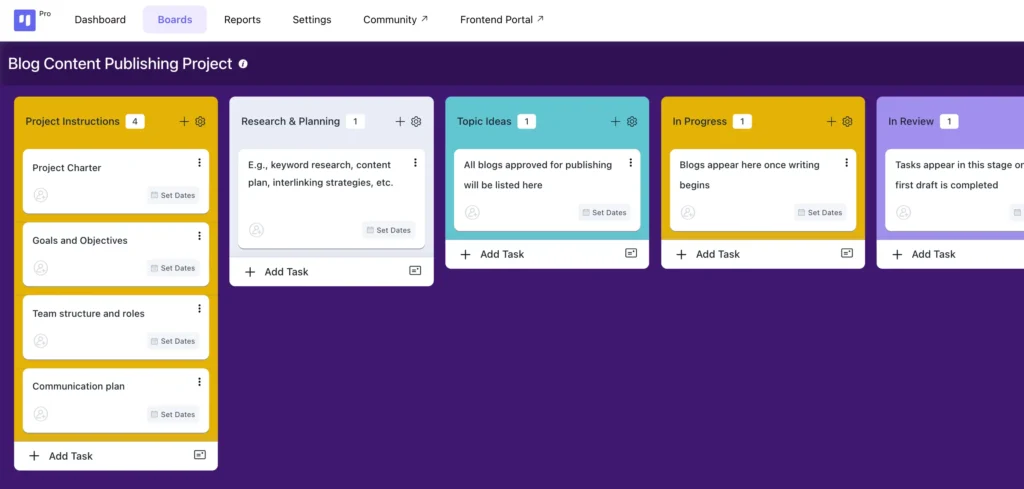
This is the shift that changes everything. When the board is ready before the kickoff, the last 10 minutes of your meeting become a live walkthrough of the actual project instead of a promise to “send something after the call.” The team leaves the kickoff with their tasks already in front of them. The client can be given access rights then and there.
Pro Tip: Build your project board 24 hours before the kickoff. Set up stages and add the first wave of tasks before anyone joins the call. Then send team members their board invites the night before, so they arrive at the meeting already oriented, not seeing the project for the first time.
During the Meeting: Kickoff Agenda That Actually Aligns The Team
A kickoff agenda that works has six sections, a hard time limit for each, and one rule: every decision made in the meeting gets logged in the project board before the call ends. Not after, not “in the follow-up”, instead, before anyone hangs up.
Here’s the structure that fits a 50-minute kickoff for a typical agency or team project:
1. Open With the “Why” (5 Minutes)
Before anyone looks at scope or tasks, spend five minutes explaining why the project exists and what success actually looks like. Focus not on features or deliverables, but on the real outcome the client or stakeholder cares about.
This is where a project charter becomes incredibly valuable. A well-defined project charter gives the team a shared understanding of the project’s purpose, objectives, success criteria, and priorities right from the start.
These five minutes are often the most important part of the kickoff meeting because they create a common standard for decision-making. When scope questions arise later in the project, the team should be able to ask, “Does this support the outcome we agreed on?” If they can’t answer that confidently, the kickoff meeting didn’t establish the right foundation.
Pro Tip: Keep it short. One or two sentences on the project goal, one sentence on the definition of done, and move on.
2. Walk Through the Scope and Deliverables (10 Minutes)
Confirm what’s in scope and, more importantly, what’s explicitly out of scope. Out-of-scope is the part most teams skip. Don’t skip it.
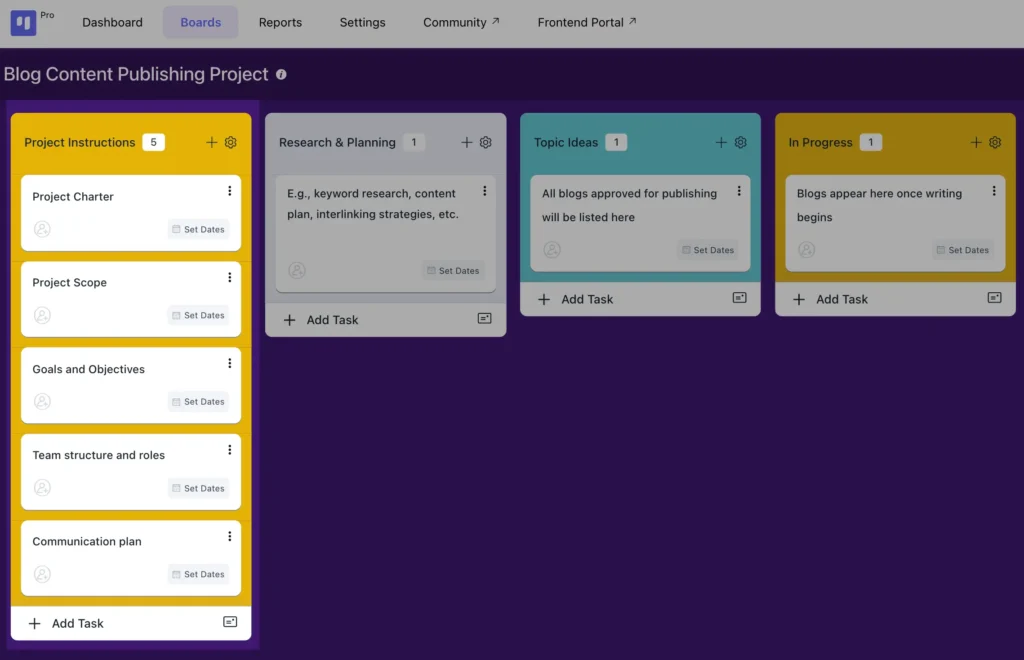
The purpose here is not to present a finished plan. It’s to get verbal confirmation from every person in the room. Read each deliverable out loud. Ask: “Does everyone agree this is what we’re building?” Wait for actual confirmation. A silent nod in a video call is not confirmation.
Pro Tip: Log any scope changes or clarifications directly into the project board as task descriptions or project notes before the meeting ends. “We agreed to exclude mobile optimization from Phase 1” should be on the board, not just in someone’s head.
3. Assign Roles Out Loud (10 Minutes)
Go through each project deliverable and name a specific person responsible. Not “the dev team.” A name. Not “we’ll figure that out.” A name, today.
This is where most kickoffs drift. The moment you leave role assignments vague, you’ve created an accountability gap that will surface at the worst possible time. Every deliverable needs one owner. One person who says yes when you ask, “Who is responsible for this?”
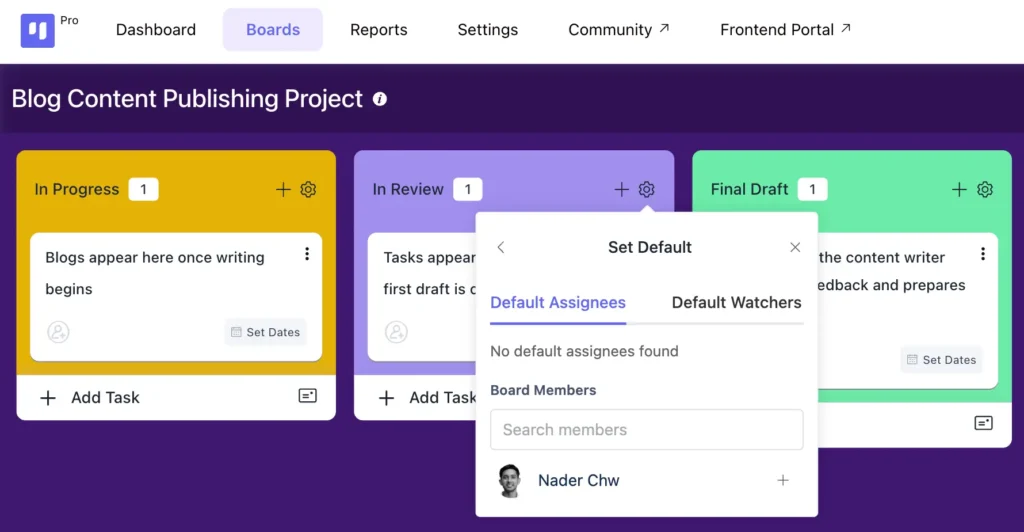
You can set a default assignee for every stage of the board, so when a task moves from “In Progress” to “Review,” it automatically gets assigned to the right reviewer without anyone having to remember. Set this up before the kickoff and walk the team through it during this section.
Pro Tip: After assigning each role verbally, immediately update the task assignee in the project board while the meeting is still running. Don’t rely on post-meeting memory. The moment someone is named as the owner of a deliverable, it should be on the board within 60 seconds.
4. Review the Project Board Together (10 Minutes)
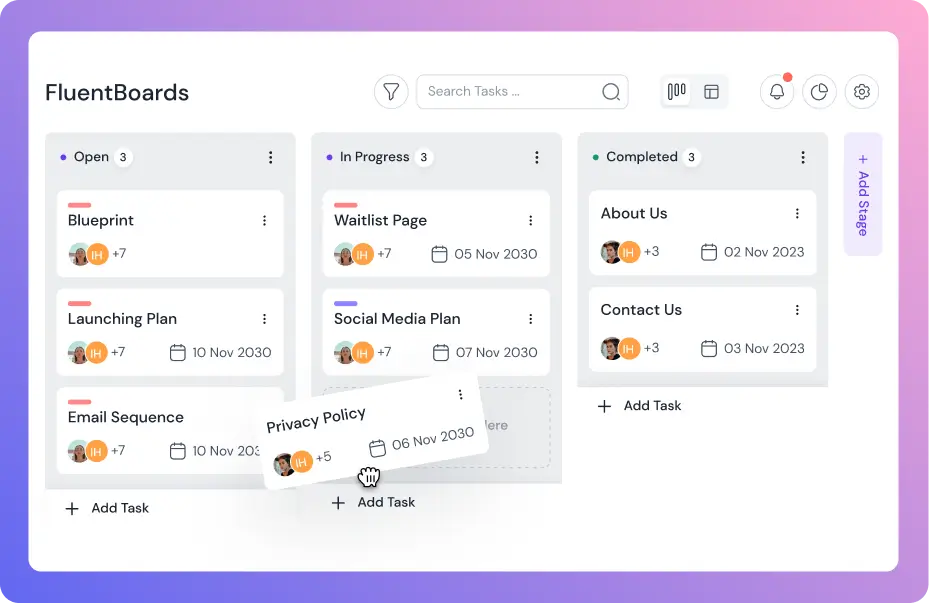
Share your screen and walk the team through the live project board. The actual board they’ll be working from for the next few weeks or months.
This is also where the project workflow is established in practice. Walk through the stage structure, explain what each column represents, and define the criteria for moving tasks forward.
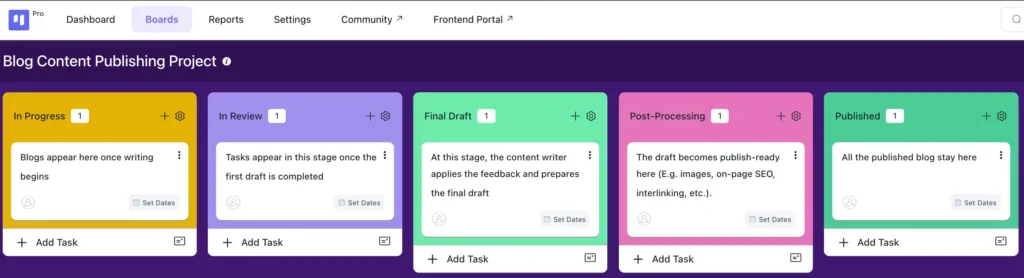
Then highlight the first milestone and clarify the top three tasks each team member is responsible for. The goal is simple: everyone should leave knowing exactly what they are doing first and how work flows through the system.
For client-facing projects, this is also the moment to explain how the Frontend Portal works. Once you activate it after the call, the client gets a real-time view of project progress without needing a WordPress login or relying on weekly status emails.
Pro Tip: Clients who can see the board tend to ask fewer anxious questions. And that’s worth setting up on Day 1.
5. Set Communication Ground Rules (5 Minutes)
Agree on three things: where questions go (Slack, email, in the task comments), how often the team syncs formally (weekly check-in, bi-weekly review), and what the escalation path is if something is blocked.
Five minutes is enough. You’re not building a communication plan here, it should already exist. You’re simply briefing the basics so everyone knows how it works in practice.
Without this alignment, the default is chaos. People start using their own systems, some ask questions in Slack, others use email, and the project manager ends up trying to track everything across multiple channels.
Pro Tip: One practical rule worth stating explicitly. If a question is about a task, it goes in that task’s comment thread in the project board. That way, the answer lives next to the work, not in someone’s inbox three weeks ago.
6. Lock In First Actions Before Anyone Leaves (10 Minutes)
The last 10 minutes are focused on one simple outcome: every person in the meeting should be able to answer, “What is the first task I’m working on, and when will it be done?”
Go around the room one by one: name, task, and deadline. Log everything directly onto the board in real time. By the end of the meeting, the project board should already have at least one assigned task per team member, each with a clear due date.
Encourage team members to also maintain their own project to-do lists for easier tracking going forward. This is what separates kickoffs that actually launch projects from kickoffs that just talk about them.
Pro Tip: The energy in a room after a good kickoff is real. The question is whether that energy turns into organized action or dissipates into “I’ll follow up later.”
After the Meeting: Keep the Alignment Alive
What you do in the 24 hours after the kickoff determines whether the alignment holds or falls apart by the end of the first week.
1. Send a brief recap within two hours
Send a brief recap within two hours of the call ending. And, the recap should be short: three bullet points covering the project goal, the scope agreements, and the first actions each person is responsible for. Include the link to the project board. That’s it. Don’t write a meeting transcript.
2. Establish the board as the single source of truth
This is more important than the recap email. From now on, the board should be the single source of truth. A well maintained project board brings transparency that would otherwise take hours of manual updates to maintain. Every update, every status change, every question goes there. If someone sends you a question about the project via email, answer it in the task comments and reply to the email with “I’ve added this to the board.” It takes two extra minutes the first time. After that, the habit builds itself.
3. Activate Frontend Portal
For client projects, activate the Frontend Portal immediately after the kickoff. Share the link in your recap email. The moment your client can see the project board in real time, a layer of unnecessary status emails disappears. They see what’s in progress, what’s done, and what’s coming next without having to ask. That transparency is one of the clearest signs of a well-run project, and it starts on Day 1.
4. Schedule the first task sync
Schedule the first task sync within 48 hours of the kickoff. Keep it short: 15 minutes, each person confirms their first task is underway or flags a blocker. The purpose isn’t to check on people. It’s to catch anything that slipped through the kickoff before it becomes a real problem.
Pro Tip: Send the Frontend Portal link in the kickoff recap email, not a week later. Clients who see the board from Day 1 set different expectations. They stop assuming the project is stuck every time they don’t hear from you, because they can see it isn’t.
Frequently Asked Questions
Here are some frequently asked questions on the project kickoff meeting and their answers:
How long should a project kickoff meeting be?
For most agency or team projects, 45 to 60 minutes is the right range. Less than 45 minutes and you’ll rush through role assignments or skip the board walkthrough. More than 60 minutes and you’re running a planning session, not a kickoff.
Who should attend a project kickoff meeting?
Every project stakeholder who makes decisions about the project or does work on the project. For a typical agency project, that means: the project manager, the lead developer, the lead designer, and the primary client stakeholder.
What’s the difference between a kickoff meeting and a discovery call?
A discovery call is exploratory: you’re still figuring out scope, requirements, and fit. A kickoff meeting happens after all of that is settled. The discovery call answers “should we do this, and what does it look like?” The kickoff answers, “We’re doing this, here’s exactly how.”
Do you need a project board before your kickoff?
You don’t need one, but it changes the quality of the meeting significantly. Teams that walk into a kickoff with a live project board already built can spend the meeting confirming decisions and orienting the team to the actual work.
Your Kickoff Is the Alignment, Not the Announcement
Most teams treat the kickoff as the moment the project starts. What it actually is: the last chance to make sure everyone is starting from the same place before work begins to diverge. The meeting is not the milestone. The system it feeds into is.
The teams that consistently run good projects don’t have better kickoff decks. They have a board that’s live before the meeting starts, roles that are named and logged before anyone hangs up, and a single source of truth that everyone references from Day 1. That structure exists with or without a perfect slide deck. And it holds up across projects, across clients, and across teams of any size.
That’s all for today. Let’s redefine project management!
Let’s redefine project management with FluentBoards!

Follow:


Get Tips, Tricks, & Updates
We won’t send you spam.



Leave a Reply