

Project Execution Phase: Key Activities, Challenges, and Best Practices


You have a signed-off project plan, an approved budget, and a team ready to work.
Then execution begins, and everything gets harder.
Schedules start to slip. Stakeholders change their minds. A task that looked simple turns out to have hidden dependencies that nobody documented.
And that confident kickoff energy? Gone by week two.
Welcome to the project execution phase: the longest, most complex, and highest-stakes stage of any project.
The vast majority of project failures trace back to problems during execution. Yet most project management content focuses more on planning frameworks, leaving practitioners without a clear map for the moment when plans meet reality.
And, this guide changes that.
Whether you’re a seasoned project manager, a team lead, or a PMP candidate building your knowledge base, you’ll find a complete, practical breakdown of what the project execution phase is, what happens during it, the challenges you’ll face, and the best practices that separate successful delivery from expensive failure.
Let’s go!
What Is the Project Execution Phase and Where It Sits in the Project Lifecycle
The project execution phase is the third stage of the project management life cycle where the work defined in the project plan is actually performed. It’s typically the longest phase and consumes the largest share of the project budget.
It’s where the majority of the project team does the majority of their work. Teams carry out their assigned tasks, deliverables are built and tested, budgets are spent, and risks that once lived on a spreadsheet become real problems that need real solutions.
And that’s exactly why it deserves more attention than it usually gets!
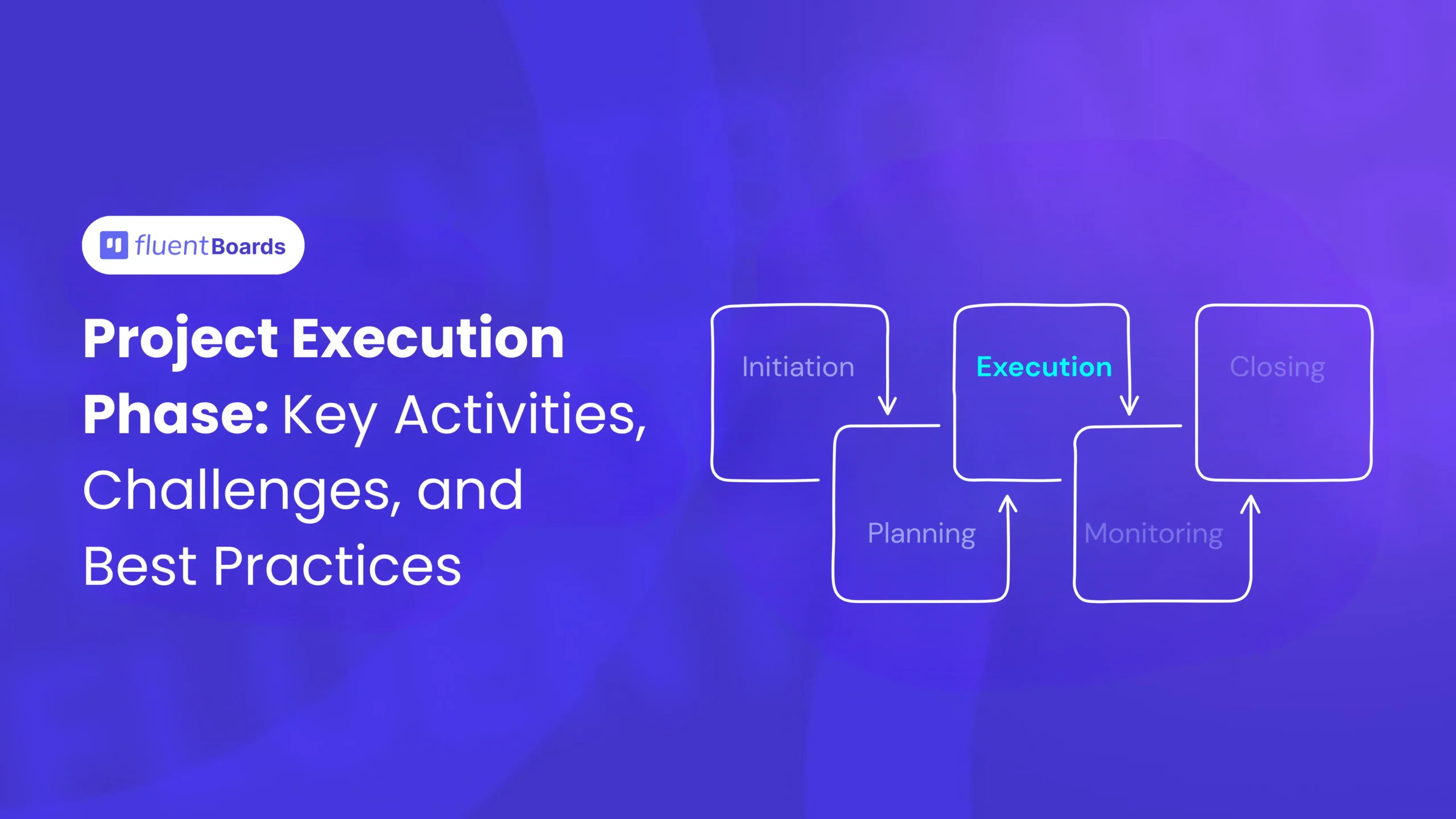
In the five-phase model defined by PMBOK (Project Management Body of Knowledge), the phases fit together like this:
- Initiation: Define the project, secure authorisation, and appoint a project manager
- Planning: Build the schedule, budget, risk register, and communication plan
- Execution: Carry out the work and produce deliverables
- Monitoring and Controlling: Track progress, manage changes, and correct course
- Closure: Hand over deliverables, formally close the project, and document lessons learned
Bonus Info: The project execution phase is also called the “implementation phase” in some methodologies.
How Long Does the Project Execution Phase Last?
The honest answer is: it depends entirely on the project, and that’s not a cop-out. For most mid-sized projects, execution typically accounts for 50 to 70% of the total project timeline.
A large infrastructure project can spend years in execution. A marketing campaign might wrap its execution cycle in a few focused weeks.
However, what matters isn’t the duration, but the consistency: clear ownership, visible progress, and active management throughout, regardless of how long the phase runs.
And, if you’re spending more time planning than doing, something’s off.
Why Does the Project Execution Phase Matter?
Project execution is the phase where the project becomes real: resources get spent, deliverables get produced, and the work your team put into planning either proves itself or falls apart under the pressure of reality.
Here’s why the execution phase deserves your full attention:
- It’s where value is actually created. No execution means no deliverables, no outcomes, and no return on the investment made in planning.
- Most budget overruns and timeline slips originate here, not in the planning room.
- Strong execution keeps project stakeholders confident and reduces the need for damage control at the end of the project.
- Team coordination is genuinely tested during execution. Misalignment that seems minor in week one tends to compound quickly.
- Issues that go unmanaged during execution always become more expensive to fix the longer they’re ignored.
Bonus Info: PMI research puts the cost of poor project performance at 11.4% of total investment, and most of that waste happens right here.
Project Execution Phase vs. Planning Phase: How the Focus Shifts
A common mistake is treating the execution phase like an extension of planning.
But it isn’t!
| Planning Phase | Execution Phase |
| Define scope and objectives | Carry out tasks to meet those objectives |
| Build the project schedule | Follow, adjust, and maintain the schedule |
| Identify risks | Monitor, escalate, and resolve risks |
| Allocate budget | Track spending and manage variance |
| Establish communication protocols | Execute communications and manage stakeholders |
| PM role: Architect | PM role: Leader, facilitator, problem-solver |
Both phases matter, but the demands they place on the project manager are quite different.
During the project planning phase, the project manager acts like an architect: designing the roadmap, anticipating risks, and building governance structures.
While during execution, that role transforms into something closer to a conductor: keeping everything in harmony, resolving conflicts, and maintaining momentum.
Project Execution vs. Project Monitoring: What’s the Difference?
Many practitioners, and even some study guides, treat execution and monitoring as sequential phases.
But, they aren’t.
As per PMBOK, the project monitoring phase runs concurrently alongside execution for the entire duration of the project.
Here’s the simplest way to tell them apart:
- Execution is about doing the work: assigning tasks, managing resources, building deliverables, and keeping stakeholders informed.
- Monitoring is about checking the work: comparing actuals to the plan, catching variance early, managing change requests, and responding to issues before they escalate.
Think of it like driving a car!
Execution is steering, accelerating, and navigating the road ahead. Monitoring is watching the speedometer, checking the GPS, and noticing when you’ve taken a wrong turn.
Key Activities in the Project Execution Phase
Execution is a coordinated system of eight interdependent activities that the project manager must orchestrate simultaneously. Here’s an overview of all eight before we break each one down:
- Kickoff meeting: Align all stakeholders on goals, roles, and communication norms
- Task assignment: Distribute tasks, set owners, and deadlines
- Resource management: Allocate people, budget, and tools;
- Status reporting: Deliver regular updates to sponsors, clients, and team leads
- Quality assurance: Test deliverables against acceptance criteria before submission
- Risk management: Monitor the risk register; escalate emerging issues quickly
- Change control: Evaluate, approve, or reject scope, schedule, or budget change requests
- Documentation: Record decisions, lessons, and progress throughout execution
Now, let’s look at each one in detail.
1. Holding the project kickoff meeting
The kickoff meeting marks the formal transition from planning to execution, and it sets the tone for everything that follows.
Done well, it aligns the entire team and key stakeholders on project goals.
Done poorly, or skipped entirely, it creates the kind of ambiguity that costs weeks to unwind.
And, a strong kickoff should cover,
- The project charter and objectives
- The work breakdown structure
- The RACI matrix
- The communication plan
- A summary of key risks
- A shared understanding of project deliverables
Pro Tip: Don’t just present the kickoff agenda. Ask the team for questions and concerns before closing the meeting. Issues raised here are cheap to fix. The same issues raised in week four are not.
2. Task assignment and work implementation
This is the core of execution: translating the WBS into assigned tasks with clear owners, deadlines, and acceptance criteria.
What a good task assignment looks like in practice:
- One person owns each task, even if multiple people contribute to it
- The owner knows they own it. Confirmed, not assumed.
- Every task has a clear deliverable and a defined deadline
- Dependencies are mapped so everyone knows what they’re waiting on and who’s waiting on them
- Acceptance criteria are defined before work starts, not after someone submits something incomplete
Pro Tip: If a task is too large or vague to meet those standards, break it down further before assigning it. Remember, the most common failure here isn’t missed deadlines or insufficient effort. The real problem is ambiguity.
3. Resource management and allocation
Resource conflicts are one of the most common and least discussed execution challenges, especially in organisations where shared resources are the norm.
Resources in project management include people, budget, equipment, and software. And during execution, the project manager must continuously monitor how all of them are being used.
This means identifying overloaded team members before they burn out, spotting under-utilised capacity that could be redeployed, and catching budget variance before it becomes a crisis.
Pro Tip: Establish resource commitments before execution begins and track them actively throughout
4. Stakeholder communication and status reporting
The question isn’t whether to communicate with stakeholders during execution. It’s whether you do it proactively or reactively.
- Proactive means regular updates on a schedule
- Reactive means answering panicked messages at 5 pm on a Friday
Different project stakeholders need different things!
- Executives need status at a glance (on track, at risk, or off track)
- Clients need confirmation that their deliverables are progressing
- Team members need to understand what’s changing and why
Building communication into the execution plan from the start, and defining who gets what, in what format, and how often, is a small investment that pays significant dividends in stakeholder trust.
Pro Tip: Build communication into the execution plan, not as an afterthought. A brief weekly summary sent on Tuesday morning is more useful than a detailed report sent whenever someone asks.
5. Quality assurance and deliverable Review
By the time you reach delivery with a batch of deliverables to review, fixing quality issues is slow and expensive, and often politically awkward. The smarter approach is to build review into the work itself.
What that looks like in practice:
- Define what “done” means for each deliverable before work starts, not after
- Set acceptance criteria upfront so the person building a deliverable knows exactly what success looks like
- Schedule review steps as milestones within the timeline, not as extras tagged on at the end
- Use QA checklists and review gates to catch issues at each stage before they compound
Pro Tip: Without clear acceptance criteria, team members fill the gap with their own interpretation of what’s expected. Sometimes that works. More often, it doesn’t.
6. Issue and risk management
The risk register your team built during the planning phase can’t sit in a folder once execution starts. It needs to be a live document that’s actively updated as new risks surface and closed when existing ones are resolved.
Issues, meaning things that have already gone wrong, need owners and resolution deadlines, not just acknowledgement.
The basics that hold this together:
- Both issues and risks need named owners. Unowned items don’t get resolved.
- Every open issue needs a resolution deadline; otherwise, it drifts indefinitely
- Not everything needs to be escalated to the project sponsor, but every issue needs someone accountable for closing it
- Log issues as they surface and review the log in every weekly check-in
Pro Tip: The cost of not escalating something at the right time almost always outweighs the awkwardness of raising it early.
7. Change Control
Scope, schedule, and budget change requests are a normal part of execution. The problem isn’t the change itself; it’s unmanaged change.
Without a clear process, requests accumulate informally, assumptions get built into live work, and the project slowly becomes something different from what was originally agreed.
That’s why every change request should go through the same process: document the request, assess the impact on timeline, budget, and dependent tasks, get approval from the appropriate person before work starts, then update the plan and communicate the change to the team.
Pro Tip: Even a lightweight version of this process, like a shared document with four columns (request, impact, approved by, date), creates enough friction to stop casual additions from derailing the project.
8. Documentation
Documentation during execution isn’t a compliance exercise. It’s what protects the team when memory fails, stakeholders disagree about what was decided, or someone new joins midway through and needs to get up to speed quickly.
Record decisions as you make them, and log the reasoning, not just the outcome. Keep meeting notes, a running issue log, and a project activity log updated throughout execution.
Pro Tip: Good documentation also feeds directly into the project closure phase and makes lessons-learned sessions genuinely useful rather than a vague retrospective exercise.
What is a Project Execution Plan?
The project execution plan (PEP) is an operational document that describes how the project will be managed on a day-to-day basis during the execution phase. It is a separate document from the broader project management plan, though the two are closely related.
Where the project management plan defines what will be done, the PEP defines how execution will be governed: the communication procedures, change control steps, quality standards, risk processes, and resource tracking methods that keep delivery consistent and auditable.
5 Common Challenges During the Project Execution Phase
Knowing what tends to go wrong is half the battle. These are the five challenges that derail execution most consistently, regardless of project type or team size.
Challenge 1: Scope creep
Scope creep rarely announces itself. It starts with one small request that seems entirely reasonable. Then another arrives, and another. Six weeks into execution, the project has doubled in complexity, and the original deadline hasn’t moved.
The fix: Document every detail, assess the impact, and get approval before work starts. To learn more, read our detailed guide on how to battle scope creep.
Challenge 2: Poor communication and misalignment
When teams work asynchronously or across time zones, misalignment builds fast. One person works from an outdated brief. Someone makes a decision that affects three downstream tasks without notifying anyone. By the time the disconnect surfaces, the cost to untangle it is significant.
The fix: The root cause is almost always the same: a lack of a single source of truth for the project’s current state. When information is missing, people rely on assumptions, and in execution, assumptions are costly. This blog will help you tackle miscommunication.
Challenge 3: Resource bottlenecks
One senior developer, one subject matter expert, or one key decision-maker can block everything downstream from them. Your plan assumed they had capacity, but in practice, they’re spread across three other projects, and tasks are queuing up waiting for their input.
The Fix: Ask yourself – who on this project is a single point of failure? That’s your risk. Address it before it stalls the entire timeline, not after it already has.
Challenge 4: Unrealistic plans meeting reality
Sometimes slippage isn’t a sign of poor execution. It’s the inevitable result of a plan that was always too optimistic. Estimates were built on best-case assumptions, dependencies weren’t fully mapped, and the external factors that were supposed to cooperate didn’t.
The Fix: When this happens, the worst response is to keep running against a plan that everyone already knows is wrong. The better response is a fast replanning exercise: what can be descoped, what can run in parallel, and what does the honest timeline actually look like? A revised plan that reflects reality is worth more than an original plan that no longer does.
Challenge 5: Weak accountability
Projects stall when nobody makes decisions. When a blocker hits and the team is waiting on a judgment call, the question “who makes that call?” needs to have a clear answer.
There’s a meaningful difference between a project manager who tracks and one who leads. The first record that a task is late. The second finds out why and removes the obstacle.
The Fix: Here’s how you can ensure accountability without becoming the only thing holding it together!
Project Execution Checklist: Best Practices for a Successful Project Execution Phase
Here’s a step-by-step checklist you can use to run your project execution phase with confidence!
Step 1: Run a strong kickoff meeting
Before any work begins, bring the full team and key stakeholders together. Cover the project charter, WBS, RACI chart, communication plan, risk overview, and the definition of done for each project deliverable.
The goal isn’t just to present information. It’s to make sure every team member leaves with a clear, shared understanding of what they own and what success looks like.
Step 2: Break the plan into owned and assigned tasks
Break the project plan down into actual assigned tasks. Not “design the landing page” sitting in a document, but a specific task with an owner, a deadline, and clear acceptance criteria.
Clear task assignment means:
- One person owns each task (not “the design team”)
- That person knows they own it — confirmed, not assumed
- Dependencies are visible, so everyone knows what they’re waiting on
Before execution starts, every team member should be able to answer three questions without hesitation:
- What am I responsible for?
- What do I need before I can start?
- And who do I hand off to when I’m done?
If anyone can’t answer all three, the task assignment isn’t ready, and execution isn’t ready to begin.
Step 3: Build visibility across the team
Everyone on the project should be able to see the current status without asking.
- What’s in progress?
- What’s blocked?
- What’s done?
This isn’t about surveillance! It’s about cutting the time spent in status update conversations and putting it back into actual work. Boards, dashboards, shared workspaces, pick one format and commit to it. The tool matters less than the consistency.
Step 4: Track the right metrics from day one
Don’t wait until you’re behind to start measuring. Set up KPI tracking on day one of execution so you have a baseline and can spot deviations early.
Three metrics that matter in most execution phases:
- Schedule variance: Are you ahead or behind where you planned to be?
- Task completion rate: what percentage of planned tasks are done by their expected date?
- Budget burn rate: Are you spending at the rate the plan assumed?
If you’re not watching these three, you’re flying without instruments.
However, these are not the only metrics worth tracking. There are other project management metrics as well, and the ones you should track depend on your project type. Choose 3–5 metrics accordingly.
Step 5: Run short, regular check-ins
A focused 15-minute daily standup beats a sprawling 90-minute weekly status meeting every single time.
Three questions are all you need:
- What did I work on?
- What am I working on next?
- What’s blocking me?
Keep it tight, keep it focused on blockers, and let everything else happen async.
Step 6: Enforce the change request process
Decide on your change request process before execution starts and apply it consistently, not just to big requests, but to every out-of-scope ask. Write it down, assess the impact, get approval, then start work.
That’s the whole process. Consistency is the part that makes it work. Without this, scope creep is inevitable. With it, it’s controllable.
Step 7: Communicate with stakeholders on a schedule
Define who gets updates, in what format, and how often, and set all of that at the start of execution.
Consistent, predictable communication builds trust and dramatically reduces the number of “just checking in” messages you’ll receive from nervous stakeholders.
Step 8: Build QA into the timeline
Don’t treat quality review as something that happens after all the work is done.
Schedule review steps as formal milestones within execution, define acceptance criteria before work starts, and review deliverables as they’re completed. By the time you’re at delivery, fixing quality issues should be the exception, not the norm.
Step 9: Keep a live issues log
Every issue that surfaces during execution should be logged immediately:
- What the problem is
- Who owns the resolution
- And the deadline for closing it
Review this log in every check-in. Issues without owners and deadlines don’t get resolved. They drift until someone notices they’ve become a project-level risk.
Step 10: Watch your metrics and react early
A small course correction in week two is always cheaper than a significant recovery effort in week six.
Check schedule variance, task completion rate, and budget burn rate on a weekly basis. When a metric starts to drift, investigate immediately rather than waiting for the next formal review.
Real-Life Project Execution Example: A Marketing Team Launches a Website Redesign
In the project initiation phase, the team aligned on the need for a website redesign and secured the budget. In the project planning phase, they mapped out tasks, timelines, dependencies, and resource assignments. Now it’s time to execute.
Here’s how a well-run team moves from plan to delivery.
Kickoff (Day 1)
The project manager runs a structured 60-minute kickoff. The team walks through the project charter, WBS, RACI assignments, and communication plan together. Everyone leaves with explicit ownership of their workstreams, a shared definition of done for each deliverable, and a Monday standup scheduled for the full team. FluentBoards is configured with all tasks, deadlines, and dependencies before end of day.
Setup (Week 1)
Tasks are broken down and assigned individually, each with a single owner and a defined deadline: content audit to Anna (Content Lead) by the end of the week, homepage wireframes to James (UX Designer) by the end of week two, development environment setup to the dev lead by Friday. KPI tracking is live from day one, and the baseline is set.
Work in Progress (Weeks 2 to 3)
At the Monday standup, the design team flags a blocker: two key wireframes are waiting on final copy that hasn’t been approved yet. The dependency wasn’t visible in the original plan, but it surfaces early enough to fix without impacting the timeline. The PM pulls the copy approval forward the same day, and the design work continues uninterrupted.
A Scope Request Arrives (Week 4)
A senior stakeholder asks the team to add a live chat feature to the redesign. The PM documents the request, runs it through the change request process, and the impact assessment shows an additional two weeks and $3,000. The request is deferred to phase 2 with the stakeholder’s agreement, and execution continues on schedule.
QA and Delivery (Weeks 5 to 6)
Each page section is reviewed against acceptance criteria as it’s completed rather than as a batch at the end. Issues are logged and resolved inline. The website ships on time, within budget, with every deliverable meeting the criteria the team defined at the start of the project. That’s what clean execution looks like.
Tools That Support the Project Execution Phase
During execution, you need coverage across three core areas: task tracking, stakeholder communication, and progress visibility. What you’re looking for is the ability to see who’s working on what, what’s blocked, and how close you are to each milestone, without manually updating five different spreadsheets to answer those questions.
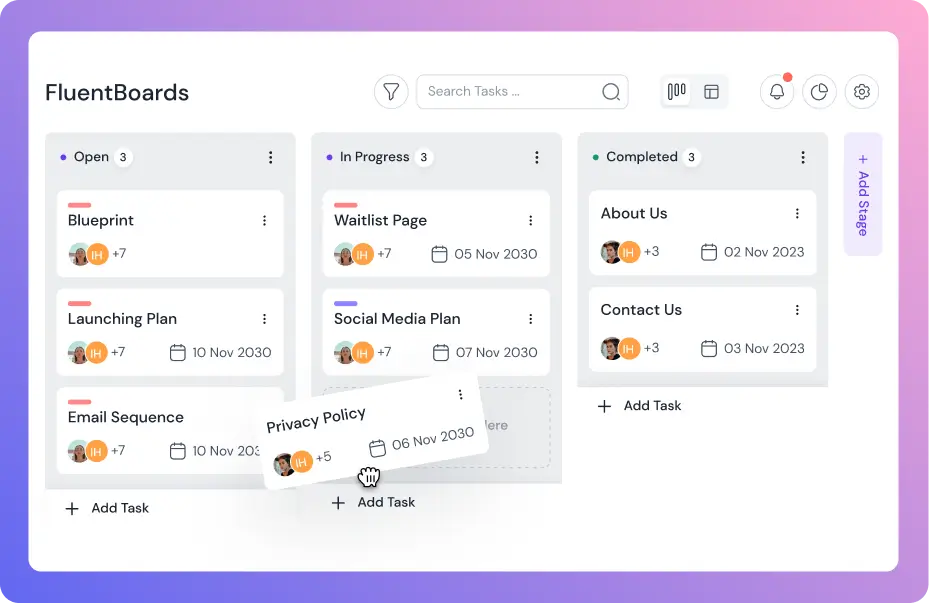
FluentBoards is a Kanban-based project management tool built for WordPress teams. It keeps tasks, deadlines, and team assignments in one place, with the kind of board-level visibility that makes execution tracking genuinely useful. If your team is already in the WordPress ecosystem, it covers the core execution workflow without adding unnecessary overhead.
Beyond your primary project tool, it’s worth having a communication platform your team actually uses (not one they were told to use), a lightweight time tracker if budget accuracy is important for your projects, and a shared dashboard that stakeholders can check without emailing you for an update.
Level up your project management game inside WordPress – where limitless possibilities come at an unbeatable price!
Drive Every Project to Success
Execution is where projects are won or lost. Not in planning sessions, not in kickoff meetings, but in the daily work of keeping a complex system of moving parts moving in the right direction.
The teams that consistently deliver share a recognisable set of habits: they run strong kickoffs, assign work with clarity, communicate status on a fixed schedule, treat scope changes as formal requests, surface blockers before they compound, and measure progress from day one rather than from the point things start going wrong.
None of that is complicated. All of it requires discipline when the project gets busy and the temptation is to skip the process and just push through. Run the checklist above against how your current projects actually operate. Where’s the gap? That’s your starting point.
That’s all for today. Thanks for reading, and best of luck ahead.
Let’s redefine project management with FluentBoards!

Follow:


Get Tips, Tricks, & Updates
We won’t send you spam.




Leave a Reply