


Project Estimation 101: How to Estimate Any Project With Confidence


Every project starts with a deadline.
A stakeholder asks for a delivery timeline, the team aligns on a date, and work begins. The estimate feels reasonable on paper and everyone moves forward with confidence.
Then reality sets in.
Two weeks in, the project scope is wider than the brief suggested. Three weeks in, a blocked dependency is holding up two critical tasks. By the final sprint, everyone is working overtime just to hit the deadline.
And the estimate committed on day one is the reason why.
In this guide, we’ll break down what project estimation actually is, why estimates go wrong, the three methods that hold up in practice, and the data habit that makes every future estimate sharper than the last.
Let’s dive in!
What Is Project Estimation?
Project estimation is the process of predicting how much time, money, and effort a project will need before work begins.
It is the foundation of everything that follows in the project planning phase. Once you know how long the work will take and what it will cost, you can sequence tasks, allocate resources, and set deadlines that the team can actually hit.
Most teams estimate three things:
- Time: how many calendar days, weeks, or months the project will span
- Cost: how much money the project will consume, including labor, tools, and contingency
- Effort: how many person-hours of actual work the project will require
These three are connected but not identical, and treating them as the same number is where most estimation mistakes begin.
How Time, Cost, and Effort Differ in Project Estimation
Time is calendar duration, cost is the financial total, and effort is the person-hours of actual work. Three different numbers that most teams treat as one, and pay for it later.
Here’s how they differ:
| Term | What it measures | Example |
|---|---|---|
| Effort | Total work in person-hours | “This task is 40 hours of work” |
| Time (Duration) | Calendar time the work spans | “This task will take two weeks on the calendar” |
| Cost | Financial value of the effort and duration | “This task costs $2,400 at a $60/hour rate” |
The three move independently. A 40-hour effort task can finish in:
- One week if one person does it full-time
- Two and a half days if three people split it
- A full month if someone works on it part-time around other commitments
The cost changes too, depending on who does the work and at what rate. Three junior developers cost less per hour than one senior, but the senior may finish faster with less rework. Same effort, different time, very different cost.
Why teams confuse the three
Small teams treat them as one thing because they often are. One person, full-time, on one task: “8 hours of effort over 1 day at 1 person’s rate.” Easy.
The moment you add parallel work, dependencies, or part-time contributors, the three numbers diverge fast.
- When you commit to a client deadline, you’re committing to time.
- When you commit to a budget, you’re committing to cost.
- When you assign work to your team, you’re managing effort.
Mixing them up is how projects come in late, over budget, or both at once.
Level up your project management game inside WordPress – where limitless possibilities come at an unbeatable price!
The Importance of Accurate Project Estimation
Estimation is the silent decider of whether a project succeeds or struggles.
According to McKinsey research, large IT projects run 45% over budget on average, and the Project Management Institute estimates that organizations waste 11.4 cents of every dollar spent on projects due to poor performance.
Here are the key reasons accurate estimation matters:
Set realistic expectations with stakeholders
A clear estimate gives clients, executives, and team members a shared understanding of what’s coming. No one likes surprises, especially financial ones.
Protect your project margin
Underestimating a project is the fastest way to lose money. If you quote a fixed price based on a bad estimate, the gap comes out of your margin, not the client’s wallet.
Prevent team burnout
Bad estimates force teams to rush, work nights, and cut quality to hit deadlines that were never realistic. Honest estimates protect your team’s energy.
Make smarter resource allocation decisions
When you know how much effort each project needs, you can plan work without overloading anyone. Capacity planning depends on it.
Build trust through delivery
The teams that consistently hit their estimates build a reputation. The teams that miss consistently lose business, even when their actual output is good.
Spot risks earlier
The act of estimating forces you to think through what could go wrong. Tasks that feel “uncertain” during estimation often become the actual delays during execution.
The Three Project Estimation Methods Worth Learning
The three methods that cover most real-world projects are analogous estimating, bottom-up estimating, and three-point estimating. Each suits a different stage of project planning.
Other methods exist (parametric estimating, expert judgment, the Delphi technique) but these three give you the most practical coverage with the least overhead.
Analogous estimating: the fast one
Analogous estimating uses a similar past project as the baseline for the new one. It’s the fastest method and the least accurate.
A web design agency that just delivered a restaurant website for $8,000 over six weeks gets asked to quote a second restaurant site. They quote $8,000 and six weeks. That’s analogous estimating in action.
When it works:
- Early in the project, before scope is locked
- When you have genuinely similar past projects to reference
- For rough estimates that stakeholders need quickly
When it falls apart:
- The “similar” project wasn’t actually that similar
- The team or technology has changed since the reference project
- You have no past data and are essentially guessing
Use analogous estimating for early conversations, not final commitments.
Bottom-up estimating: the accurate one
Bottom-up estimating breaks the project into its smallest work units, estimates each one individually, then sums the estimates to get the project total. It’s the slowest method and the most accurate.
The breakdown works best when every task and subtask is named upfront. Estimate each task, add them up, and you have a project-level number grounded in actual work.
When it works:
- Once scope is defined and you have a real task list
- For project-level commitments like a fixed bid
- When accuracy matters more than speed
When it falls apart:
- You estimate before scope is real, so the estimates are fiction
- You forget to include “glue” work like meetings, reviews, and handoffs
- You sum the numbers without adding contingency
Bottom-up gives you the most defensible estimate, but only if the breakdown is honest. Padding every task by 20% isn’t bottom-up estimating, it’s fudge-factor estimating.
Three-point estimating (PERT): the realistic one
Three-point estimating accepts that you don’t know exactly how long a task will take, so you estimate three numbers: optimistic, most likely, and pessimistic. Then you weight them with the PERT formula.
The formula:
(Optimistic + 4 × Most Likely + Pessimistic) ÷ 6
A quick example. Building a checkout page integration:
- Optimistic: 8 hours (everything connects cleanly)
- Most likely: 16 hours (normal complications)
- Pessimistic: 40 hours (something breaks badly)
- Estimate: (8 + 4×16 + 40) ÷ 6 = 18.7 hours
The estimate sits close to most likely but stretches toward the pessimistic, because real work usually runs into something.
Note: The formula multiplies “most likely” by four because that scenario carries the most statistical weight. It reflects what actually happens under normal conditions. The optimistic and pessimistic values pull the result without dominating it.
When it works:
- Tasks with real uncertainty, like new technology, unclear requirements, or complex integrations
- Risk-aware estimates for client or executive audiences
- When you want a defensible single number that accounts for what could go wrong
When it falls apart:
- You make up the three numbers without thinking through what could actually go wrong
- You apply it to every task including the simple ones, and slow planning to a crawl
The Project Management Institute considers three-point estimating the most accurate single-task technique because it forces you to confront risk instead of pretending the best case is the only case.
How to Estimate Your Project Step by Step
AThe three methods that cover most real-world projects are analogous estimating, bottom-up estimating, and three-point estimating. Each suits a different stage of project planning.
Other methods exist (parametric estimating, expert judgment, the Delphi technique) but these three give you the most practical coverage with the least overhead.
Analogous estimating: the fast one
Analogous estimating uses a similar past project as the baseline for the new one. It’s the fastest method and the least accurate.
A web design agency that just delivered a restaurant website for $8,000 over six weeks gets asked to quote a second restaurant site. They quote $8,000 and six weeks. That’s analogous estimating in action.
When it works:
- Early in the project, before scope is locked
- When you have genuinely similar past projects to reference
- For rough estimates that stakeholders need quickly
When it falls apart:
- The “similar” project wasn’t actually that similar
- The team or technology has changed since the reference project
- You have no past data and are essentially guessing
Use analogous estimating for early conversations, not final commitments.
Bottom-up estimating: the accurate one
Bottom-up estimating breaks the project into its smallest work units, estimates each one individually, then sums the estimates to get the project total. It’s the slowest method and the most accurate.
The breakdown starts with a work breakdown structure (WBS) — splitting the project into every task and subtask before estimating each one. Add those estimates up and you have a project-level number grounded in actual work, not guesswork.
When it works:
- Once scope is defined and you have a real task list
- For project-level commitments like a fixed bid
- When accuracy matters more than speed
When it falls apart:
- You estimate before scope is real, so the estimates are fiction
- You forget to include “glue” work like meetings, reviews, and handoffs
- You sum the numbers without adding contingency
Bottom-up gives you the most defensible estimate, but only if the breakdown is honest. Padding every task by 20% isn’t bottom-up estimating, it’s fudge-factor estimating.
Three-point estimating (PERT): the realistic one
Three-point estimating accepts that you don’t know exactly how long a task will take, so you estimate three numbers: optimistic, most likely, and pessimistic. Then you weight them with the PERT formula.
The formula:
(Optimistic + 4 × Most Likely + Pessimistic) ÷ 6
A quick example. Building a checkout page integration:
- Optimistic: 8 hours (everything connects cleanly)
- Most likely: 16 hours (normal complications)
- Pessimistic: 40 hours (something breaks badly)
- Estimate: (8 + 4×16 + 40) ÷ 6 = 18.7 hours
The estimate sits close to most likely but stretches toward the pessimistic, because real work usually runs into something.
Note: The formula multiplies “most likely” by four because that scenario carries the most statistical weight. It reflects what actually happens under normal conditions. The optimistic and pessimistic values pull the result without dominating it.
When it works:
- Tasks with real uncertainty, like new technology, unclear requirements, or complex integrations
- Risk-aware estimates for client or executive audiences
- When you want a defensible single number that accounts for what could go wrong
When it falls apart:
- You make up the three numbers without thinking through what could actually go wrong
- You apply it to every task including the simple ones, and slow planning to a crawl
The Project Management Institute considers three-point estimating the most accurate single-task technique because it forces you to confront risk instead of pretending the best case is the only case.
How to Estimate Your Project Step by Step
A solid project estimate follows four steps: define scope, break the work into smaller units, pick the right method for each task, and add a contingency buffer. Here’s how each one works.
Define scope first
An estimate without a scope is fiction. You can’t price work that isn’t defined.
Before estimating, write down what the project will deliver, what it will not deliver, and the acceptance criteria for each deliverable.
Our project scope guide covers this in full.
The short version: if you can’t describe the finished thing in writing, you’re not ready to estimate.
Break the work into smaller units
Estimating “build the website” is impossible. Estimating “design the homepage, build the contact form, integrate the payment gateway, write the copy, test on three browsers” is doable.
A work breakdown structure is the tool that makes this possible, it breaks the project into every deliverable, task, and subtask before a single estimate is written. Each unit should be small enough that one person can estimate it confidently, usually under 20 hours of effort.
Pick the right method for each task
Most teams choose one method and apply it across every task. That’s wasteful.
A better approach:
- Analogous for tasks similar to past work, like “another contact form”
- Bottom-up for tasks where scope is clear and detail matters
- Three-point for tasks with real uncertainty, like “integrate with the new vendor API”
One project. Three methods. The method matches the risk of the task.
One rule that beats every method: get the estimate from the person who will actually do the work. Project managers often estimate tasks they don’t fully understand. The developer, designer, or specialist doing the work knows where the hidden complexity lives. Collect their estimates, then add a management buffer, not the other way around.
Add a contingency buffer based on where you are
The Project Management Institute publishes accuracy ranges for project estimates based on how much is actually known at the time of estimating:
| Estimate type | When you produce it | Accuracy range |
|---|---|---|
| Rough Order of Magnitude (ROM) | At project initiation | Plus or minus 50% |
| Budget estimate | During planning | Minus 10% to plus 25% |
| Definitive estimate | During execution | Minus 5% to plus 10% |
Your buffer should reflect where you are. A ROM estimate is expected to be rough. A definitive estimate has no excuse for being more than 10% off.
Pro Tip: Many teams present a ROM estimate as a firm price. This sets stakeholders up to expect near-perfect accuracy from a number that always carried plus or minus 50% variance. When you share an early estimate, always label it. “This is a rough order of magnitude, we’ll sharpen it once scope is locked” protects you and sets honest expectations from the start.
Step into the Future of Project Management!
Why Your Past Projects Are Your Best Estimation Tool
The single biggest improvement most teams can make to their estimation accuracy is also the simplest: track what actually happens.
When a project closes, how long did each task take compared to the estimate? Where did the overruns happen? Which phases consistently take longer than planned?
This data turns every completed project into a reference library for the next one. It removes the guesswork from analogous estimation and gives parametric models an accurate baseline to calculate from. Over time, teams with strong historical tracking produce estimates that are measurably more accurate than teams without it.
The problem is that most teams do not track this data systematically. The project ends, the team moves on, and the lessons stay locked inside individual memories rather than becoming shared knowledge the whole team can build on.
How FluentBoards Helps You Estimate More Accurately Over Time
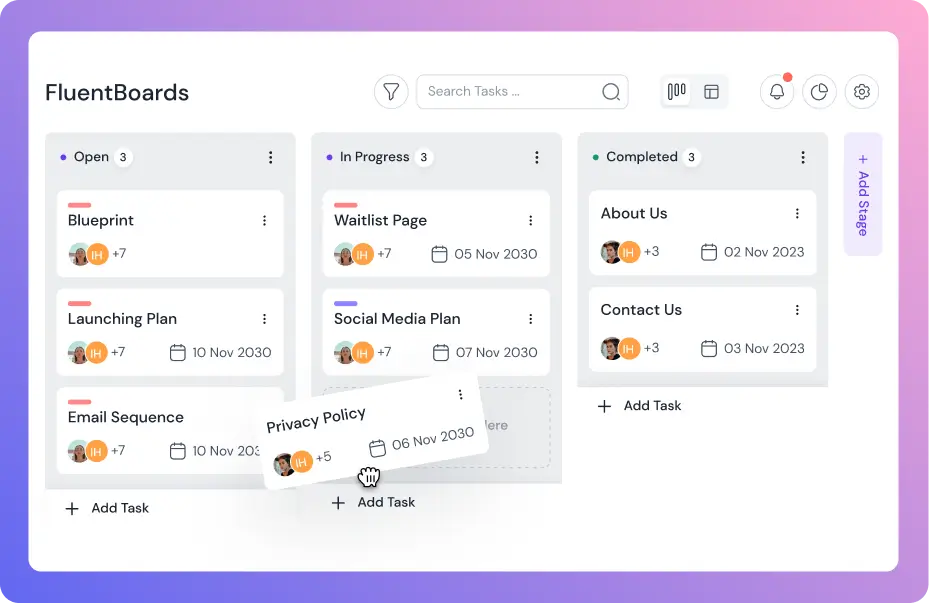
Most teams estimate the same way every time, starting from memory, adjusting by gut feel, and hoping the number holds. FluentBoards breaks that cycle by turning every project you run into data you can actually use next time.
Here is how it works step by step.
Step 1: Set an estimated time for every task
Before work begins, open any task on your board and set an estimated time directly inside it. This becomes your committed forecast for that piece of work, logged at the task level before a single hour is spent.
Step 2: Log actual hours as work happens
As team members work through their tasks, they log actual hours against the estimate in real time. You are not waiting until the project closes to find out where the time went. The gap between estimated and logged hours stays visible while the project is still running.
Step 3: Read the Timesheet Report by task and by member
Once work is underway, FluentBoards generates a Timesheet Report that breaks down estimated versus logged time across two views:
- By Task — shows which deliverables are running over or under estimate
- By User — shows which team members are forecasting accurately and which ones need adjustment
Step 4: Filter by board, date range, or contributor
Need to see how one developer tracked across a specific sprint? Or how a content team performed across a full quarter? Simply use the date filter and board selector to cut the data exactly the way you need it for a project review or retrospective.
Step 5: Export and carry the data forward
Every timesheet is exportable as a CSV. So the next time a similar project lands on your board, you are not estimating from memory. You are pulling real numbers across three things that actually matter:
- What tasks took how long
- Which team members carry which capacity patterns
- Where the estimate-to-reality gaps consistently appear
Now that is the difference between an estimate that holds and one that quietly breaks two weeks into a six-week project.
So if estimation accuracy is something your team struggles with, start by locking in your scope before committing to any number. And once your project is running, make sure your project milestones are tied to real task-level data, not just calendar dates.
Common Project Estimation Mistakes to Avoid
Most estimates miss for predictable reasons. Here are the ones to watch:
- Optimism bias pushes estimates toward the best case, especially under pressure to win the work; use three-point estimating to put the pessimistic number on the table where you can see it.
- Treating effort and duration as the same number turns a two-day task into a two-week delay the moment someone is splitting time across multiple projects.
- Ignoring meetings, reviews, and handoffs leaves a significant chunk of actual work time unaccounted for before work even starts; non-billable time belongs in the estimate.
- Estimating without the people doing the work means pricing a task the PM doesn’t fully understand; get the number from whoever will execute it, then add management buffer on top.
- Absorbing scope creep without re-estimating silently inflates the project beyond anything that was ever quoted; every scope change needs a new estimate.
Estimate Smart, Deliver Strong
Estimation isn’t a number you guess once. It’s a skill you build by checking what you said against what actually happened. The methods give you a starting point. The data habit makes you sharper every project.
The teams that estimate well aren’t smarter or more experienced. They just refuse to walk away from a finished project without looking at the gap. Set the estimate. Log the actuals. Compare them. Carry the lesson forward.
Thanks for reading, and may your next estimate land closer to reality than the last one.
Let’s redefine project management with FluentBoards!

Follow:


Get Tips, Tricks, & Updates
We won’t send you spam.





Leave a Reply